Since 1976, the Northeast Ohio Orienteering Club (NEOOC) has introduced thousands of people to the sport of orienteering. Over five decades, dedicated volunteers have created maps, organized hundreds of events, and hosted regional and national championship competitions. This history highlights many of the people, milestones, and accomplishments that shaped the club.
Club Beginnings, 1976-1983
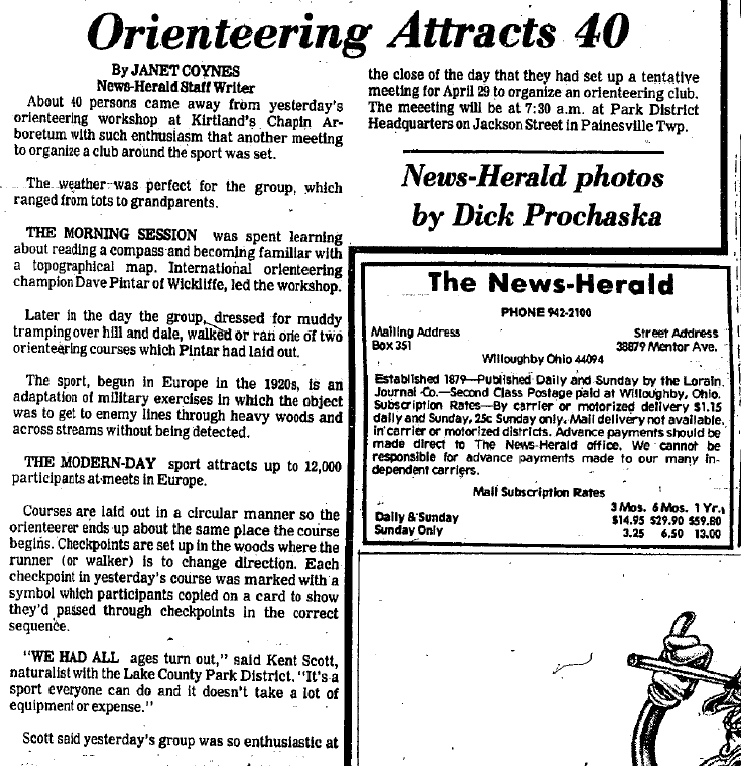
The earliest recorded history of orienteering in Northeast Ohio appears in a 1976 Lake County News-Herald clipping: “Orienteering Attracts 40. About 40 persons came away from yesterday’s orienteering workshop at Kirtland’s Chapin Arboretum with such enthusiasm that another meeting to organize a club around the sport was set.”
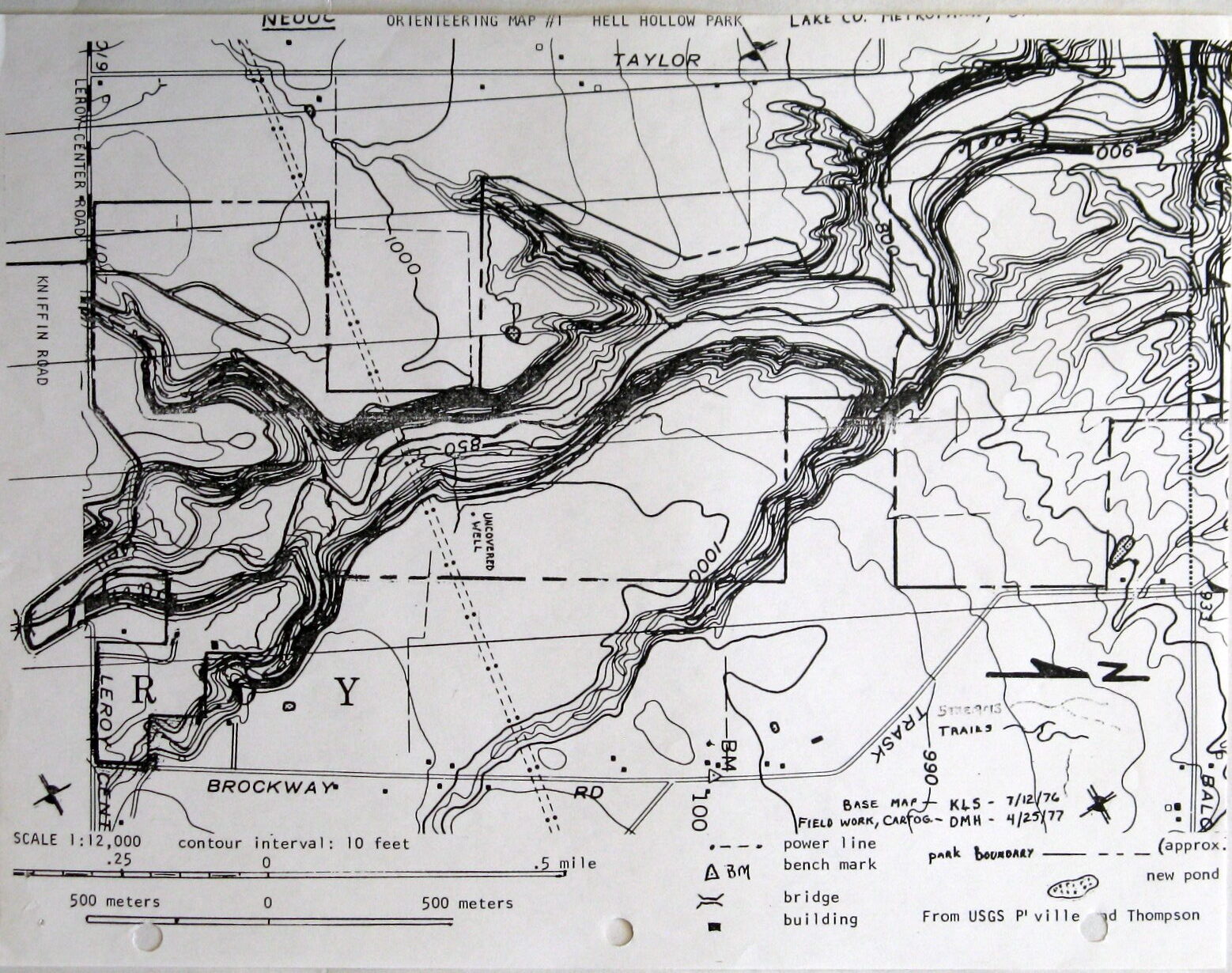
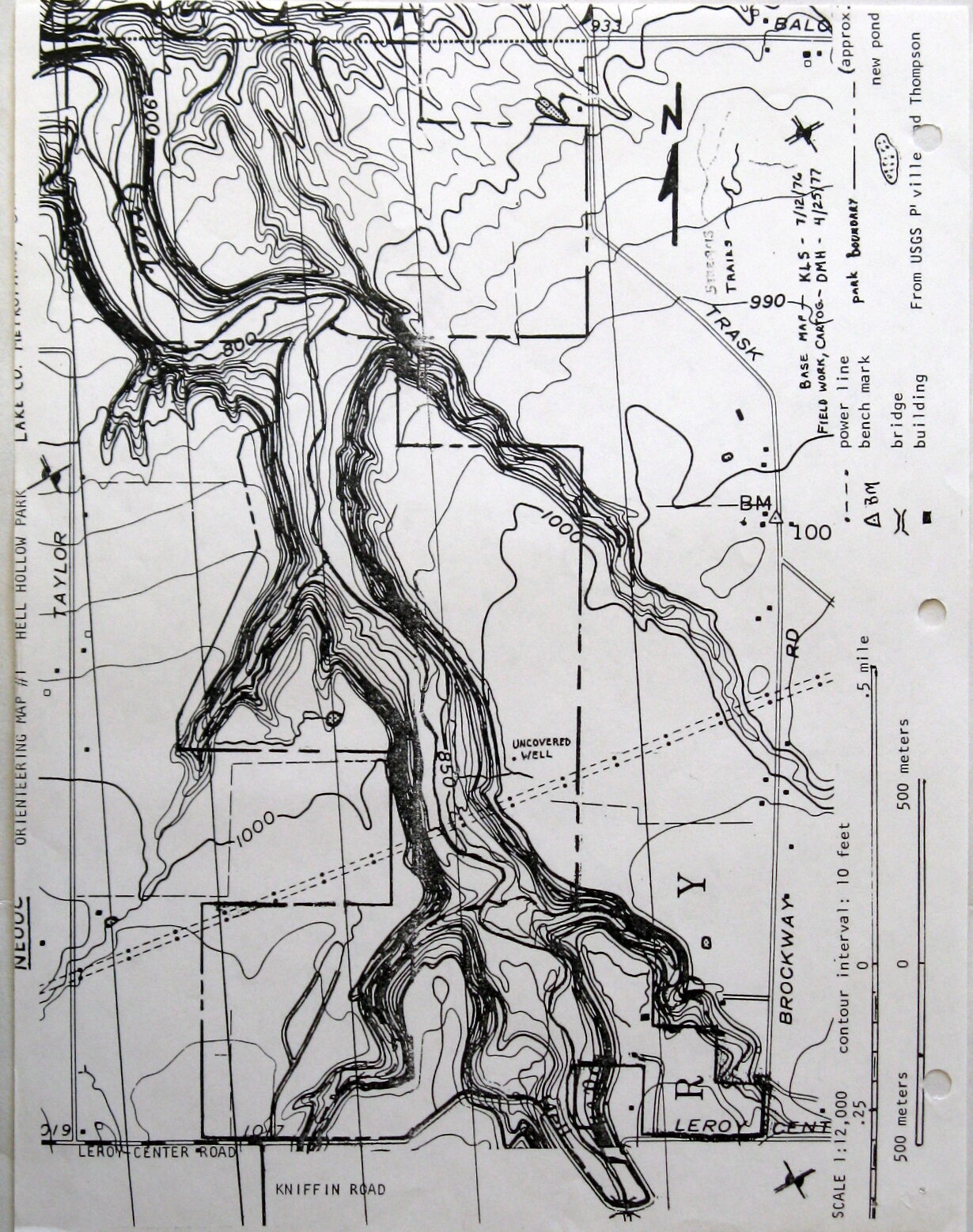
In July 1976, the club’s first meet was held at Hell Hollow Park in Lake County. Participation cost $1.00, and the map was printed in black and white.
One of the most detailed accounts of the club’s formative years was written by club secretary Bob Titus in The Grapevine in June 1979:
A Brief History of the Northeastern Ohio Orienteering Club
by Bob Titus, The Grapevine, June 1979
The Northeastern Ohio Orienteering Club was formed in 1976 by Kent Scott, a Lake County Metropolitan Parks District naturalist, and Dave Pintar, a recent Ohio University graduate and former intercollegiate champion.
After an exploratory workshop in February that year, the club was officially launched, under the auspices of the Parks District, on March 25th. Its first officers were: Dave Pintar, president; Kent Scott, treasurer; and Bob Titus, secretary. There were 8 members.
Only 3 meets were held in ‘76, all in Hell Hollow Park in Leroy, but by October the club was financially self-sufficient. By year’s end, NEOOC was 30-strong, with a bank balance of $70. Its inventory consisted of 10 compasses, 20 painted Clorox bottles and a short stack of black and white maps.
1977 was very successful, largely due to the work of Dennis Holloran, who accomplished much in his four short months as president, Nick Baldwin, the publicity chairman, and Dave Kreider, our president at that time. These and other members worked hard producing the club’s first 4-color, “official” map, staging the year’s 10 meets, making meet equipment, and sponsoring workshops for various organizations The membership count was 70 when ‘77 closed out, five of whom attended the nationals in December.
NEOOC plans to continue its growth, the first priority of becoming a USOF affiliate having been accomplished in 1978. We are presently planning another Class B for 1979 sometime in October.
By the end of the club’s second year, members and volunteers could already see the rapid progress being made. President Dave Kreider reflected on that growth in the December 1977 newsletter:
“As a club we’ve grown in size and experience. We now have about 70 members. Among the advances we’ve made this year: new control points, made by club members, a new orienteering map, made by club members, and posting results at the meets. But I can’t look back on the past year without thinking about all the good times, and I hope everyone has had as much fun as I had. The thoughts that come to my mind are of a lot of things: the campout, smiles on people’s faces as they come in off the course, just being with friends and doing something that’s really fun.”
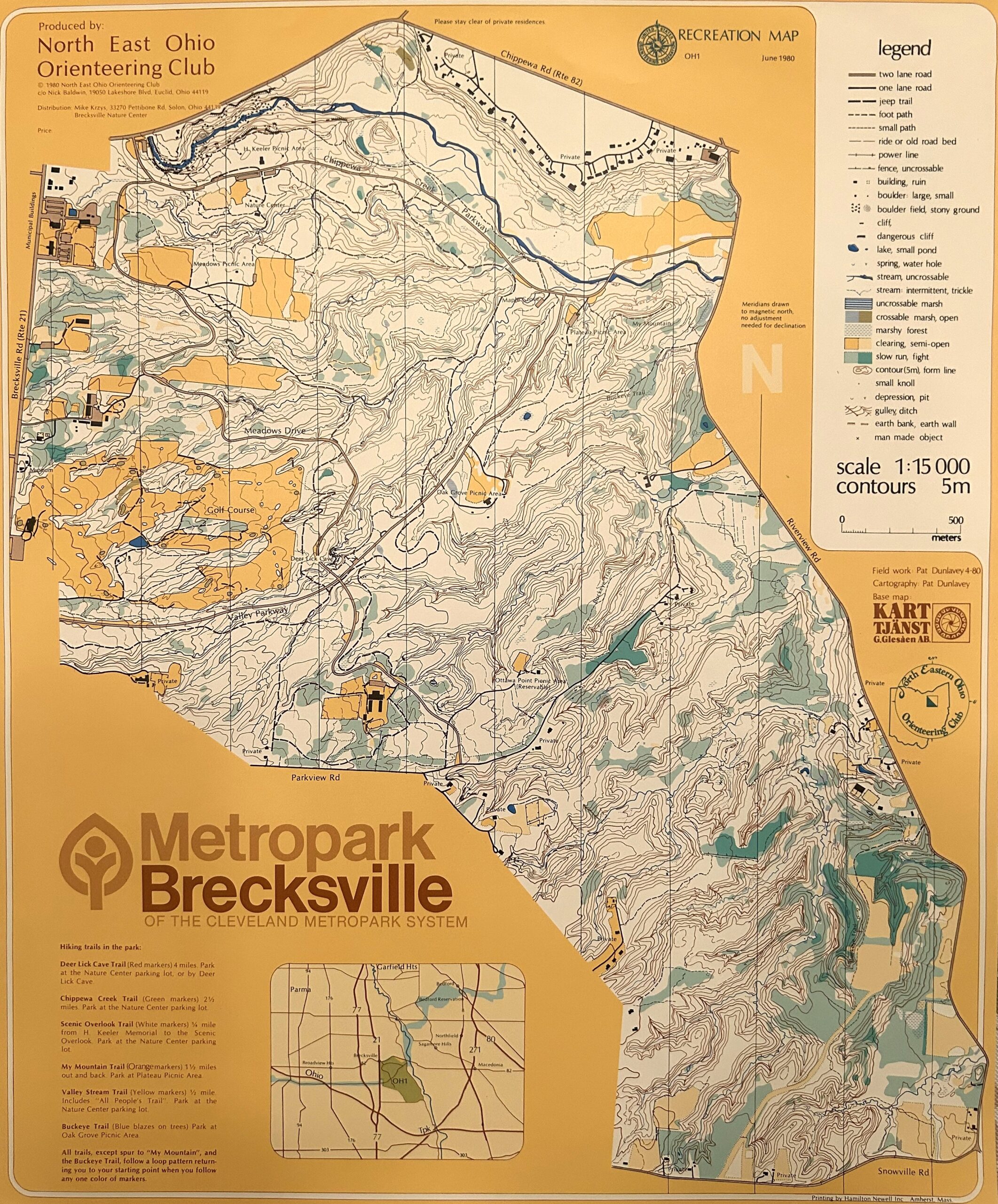
After the club’s successful start, leaders and volunteers began planning a major event for Northeast Ohio: the 1980 North American Orienteering Championships. Hosting a national-caliber event was a remarkable achievement for a club that had started with only eight members a few years earlier. The championship was held at Brecksville Reservation and attracted 391 participants from the United States and Canada.
Momentum continued after the championships. By 1981, membership had reached 96. Volunteers were creating new maps, updating existing ones, holding workshops, and hosting events at multiple venues.
Within a few short years, the club had established a strong foundation. What began with eight members and a single black-and-white map had grown into an organization capable of hosting nationally significant events and introducing countless people to orienteering.
Late 20th Century, 1984-1999
During the 1980s and 1990s, NEOOC matured into a well-established organization, hosting 10 to 20 events per year. The most commonly used venues included North Chagrin, South Chagrin, Virginia Kendall, Mill Stream Run, Hinckley, and Brecksville. Membership fluctuated but generally remained between 70 and 90 members.
The Grapevine remained the club’s primary communications channel and was published several times per year. Producing the newsletter was a substantial task, with carefully formatted event results, announcements, stories, graphics, cartoons, and games. As word processing tools improved, the newsletter took on a more personal and lively tone.
Improving mapped venues remained a high priority. Mapping clinics were frequently held to build club skills, and several international mappers from Czechoslovakia and Russia visited Northeast Ohio in the 1990s to assist with mapping efforts.
Hello from Czechoslovakia
“Tom & I visited Anton in Czechoslovakia this fall. Many of you will remember Anton as the mapper who redid the N Chagrin map. He was married in September and we had the honor of attending his wedding. He and his new bride send greetings back to the club. While there, we also had the opportunity to visit with John, George, and Milos, the three mappers who redid the Mill Stream Run and S Chagrin maps. They also send greetings to everyone. They all had many happy memories of the U.S.” – Sue Wills, December 1992
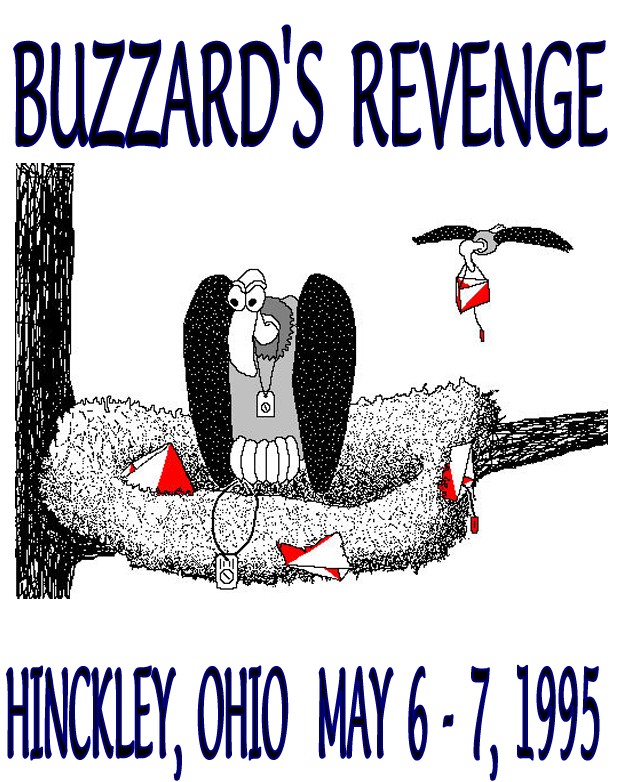
The club also embraced creativity in event design. Orienteering offerings expanded beyond the standard point-to-point format to include Ski-O, Canoe-O, Car-O, String-O, Wine-O, Boggle-O, Poker-O, Atomic-O, Time-O, and Vampire-O. Even competitive events often carried playful themes, such as the 1995 A-meet “Buzzard’s Revenge” and the 1998 Midwest Championships “Reentrants of Doom.”
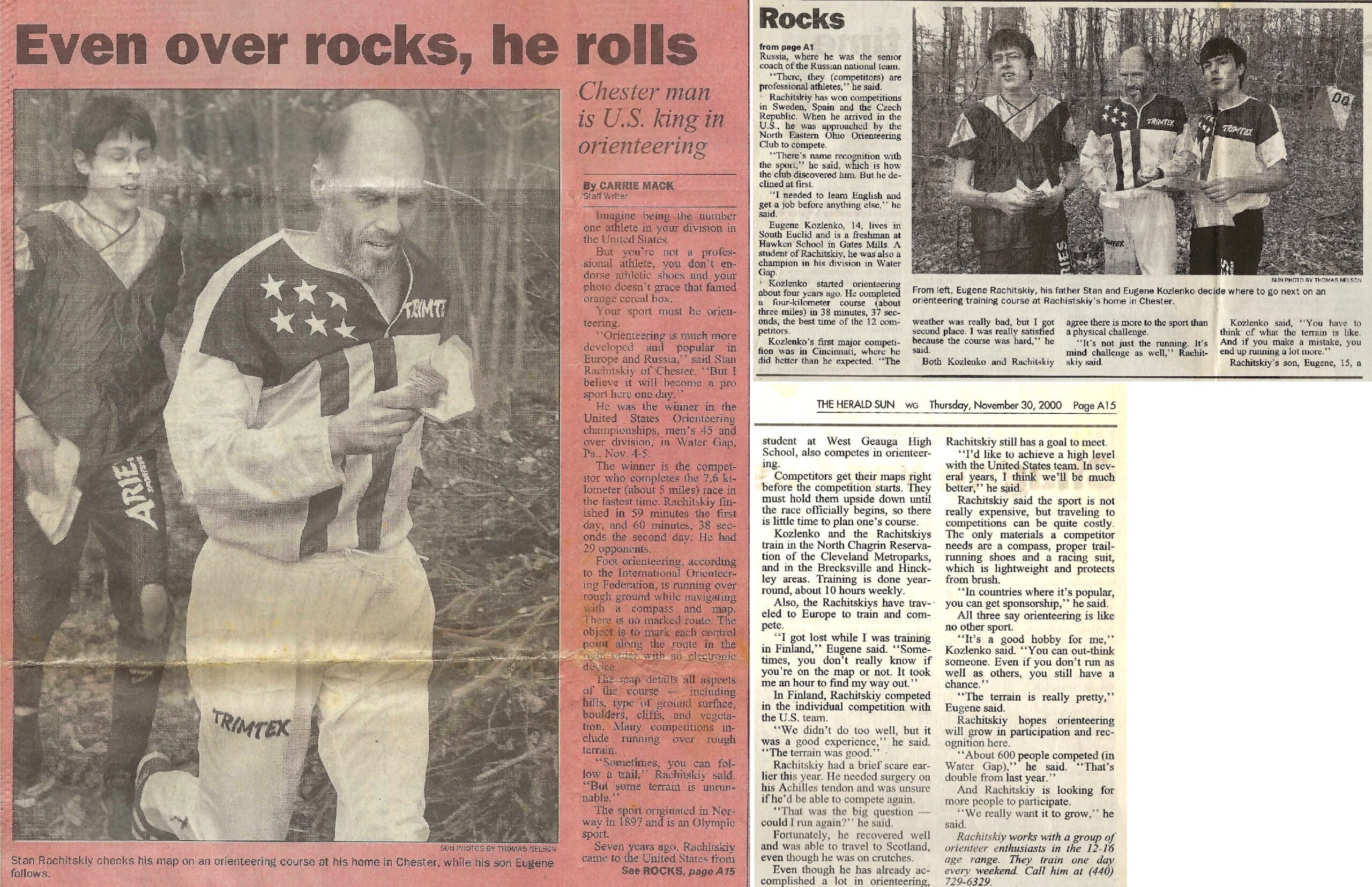
NEOOC’s involvement extended well beyond local events. Many members regularly traveled to A-meets and national championships throughout North America, representing the club in competition. Stanislav Rachitskiy, former head coach of the Russian Orienteering Team, was probably the club’s best-known and most well-traveled member, having competed and ranked highly in orienteering competitions around the world. In addition to his own competitive success, Stanislav also coached young athletes from Northeast Ohio who went on to compete nationally and internationally, including Dave Kostansek, who qualified for the US Orienteering National team in 1999.
Other club members traveled extensively as well, and their adventures were often documented in The Grapevine. Former club president Dave Karberg competed in at least ten U.S. states, including Alaska, and may hold the distinction of having traveled the farthest of any NEOOC member, competing as far away as South Korea.
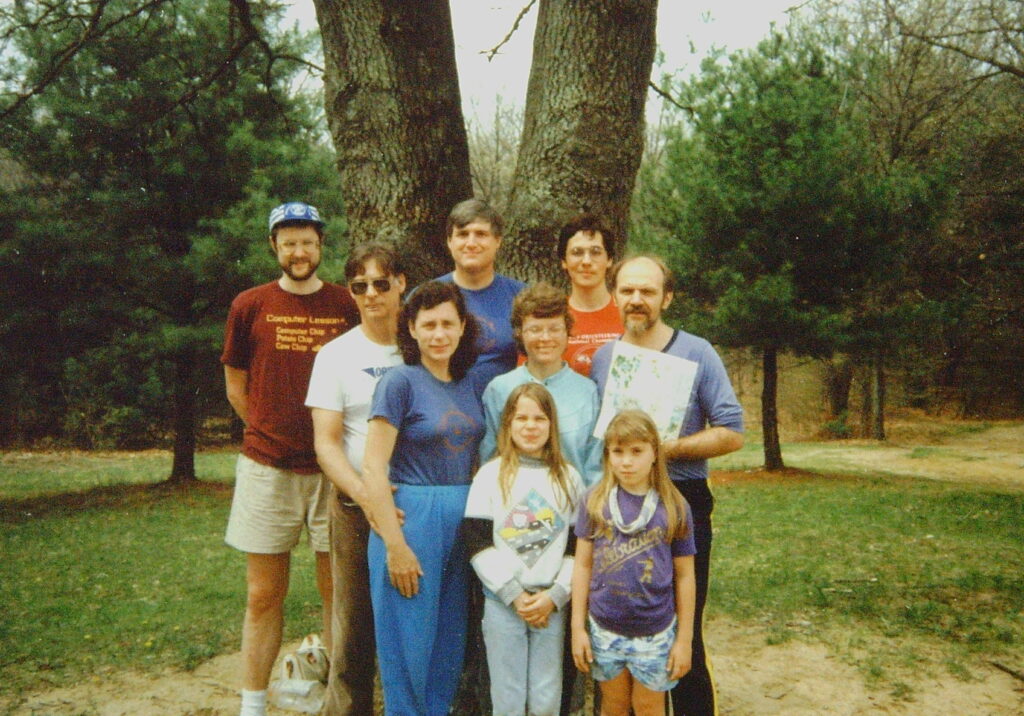
1991 A-Meet Yankee Springs (Southeast Michigan) Back Row: Angus Bond, David Karberg, Dave Kreider Middle Row: Ken Lappin, Sarah Lappin, Shirley Baldwin, Nick Baldwin Front Row: Hanna Baldwin, Heather Baldwin
Despite the club’s success, challenges remained. In 1995, NEOOC faced the potential loss of access to Cleveland Metroparks because of restrictions on off-trail use. The issue was resolved in the short term, but the relationship became strained.
The most persistent challenge, however, was recruiting volunteers for operations and event planning. Club newsletters regularly included pleas for help, and the club created a volunteer incentive program. By around 1999, organized orienteering events were close to ending because of too many open officer positions.
Fortunately, a mix of returning and new officers stepped forward. Their willingness to lead helped NEOOC enter the new millennium with renewed energy.
Member Spotlight: Angus Bond
Angus Bond was one of NEOOC’s founding members and helped create the club’s first orienteering map at Hell Hollow in Lake Metroparks. During the club’s first 25 years, he was one of its most active volunteers, serving in numerous leadership roles including parliamentarian, treasurer, equipment manager, event coordinator, and president from 1996 to 1998.
In July 1995, Orienteering North America published Angus’s article, “A Course Designer’s Diary,” which chronicled the planning and course design for NEOOC’s Buzzard’s Revenge A-meet. The article reflected the thoughtful planning and creativity he brought to course setting.
Beyond orienteering, Angus had wide-ranging interests. He enjoyed astronomy, woodworking, art, classical music, and calligraphy. He also developed a deep appreciation for both his Scottish heritage and his wife’s Chinese heritage, eventually learning to speak Mandarin Chinese.
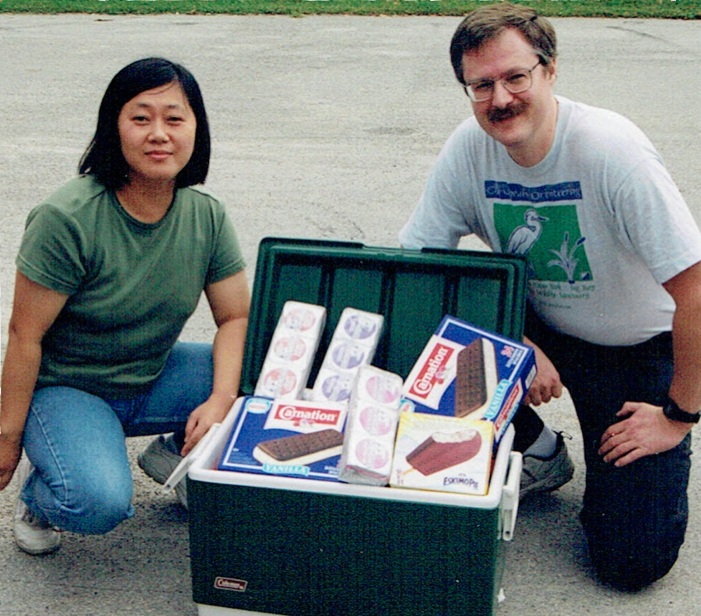
Longtime club member Bob Boltz recalled one of Angus’s memorable ideas: “The photo above is of Angus preparing to haul a load of ice cream to the beaver pond east of Kendall Lake. Angus got the idea when he noticed that the control code was ‘DQ.’ He always had tremendous energy and wisdom. Every event was better when Angus was involved.”
Angus passed away in 2017, but his enthusiasm, creativity, and dedication continue to be remembered. His contributions helped shape NEOOC during its formative years and left a lasting legacy for future generations.
Digital Modernization, 2000-2019
The turn of the century brought renewed efforts to invigorate the club. Plans were made to map new areas, increase volunteerism, and host another A-meet. At the same time, advances in technology began transforming nearly every part of the sport, from mapmaking and timing to communication and event management.
A long-distance variant of the sport, called rogaining, also made its way to Northeast Ohio. In a rogaine, participants navigate a much larger area and score points within a time limit. After testing the concept in 1997, NEOOC hosted a six-hour rogaine in Cuyahoga Valley in 2000. The event became recurring and eventually evolved into the 10-hour Python.
In 2004, NEOOC was again awarded the opportunity to host the North American Orienteering Championships. This multi-day event was held at Camp Manatoc and Cuyahoga Valley National Park, taking advantage of the scenic but intricate terrain at Virginia Kendall. Several nationally and internationally recognized orienteers participated.
Mapping remained a major focus of the club. NEOOC was again aided by international mapper Yefim “Fima” Schtempler of Ukraine. At the same time, LiDAR imagery dramatically improved the quality and accuracy of contour mapping, while GPS made fieldwork more precise than ever before.
Around 2010, electronic punching replaced manual pin punches, allowing results to be processed almost instantly. Printing technology also improved, making preprinted courses the standard and eliminating the need for competitors to copy courses from a master map before starting.
Although technology improved event operations, planning and coordination still required significant effort. Club members and volunteers devoted many hours to preparing equipment, managing registration, communicating with participants, planning and setting courses, and posting results in all kinds of weather. One especially important volunteer was Mark Stypczynski. As Howard Montgomery described it, “From the very early 2000s to his last volunteer Event Director stint with us in 2019, Mark ‘The Hardest Working Man in Show Business’ Stypczynski was the glue that kept events going.” He often served multiple roles at once and was also instrumental in securing approval for the club’s first permanent course in Brecksville.
The digital age also marked the end of The Grapevine, whose last known issue was published around 2006. Email became the norm for member communication, allowing the club to reach members more quickly than ever before. By the end of the 2010s, NEOOC had fully embraced the digital tools that continue to support the club today.
Member Spotlight: “Boulder Bob” Boltz
Bob Boltz, a former science teacher, joined NEOOC in 1991 and became the club’s principal mapper during the digital modernization years. When he began mapping, Bob had no prior experience and learned the craft from scratch.
Bob recalls the early days of mapmaking before GPS and LiDAR transformed the process. Mappers began with U.S. Geological Survey topographic maps, tracing contour lines by hand before heading into the field. There, they painstakingly paced distances, measured directions, identified terrain features, and filled notebooks with observations that would later become detailed orienteering maps.
Bob’s first major mapping project was Quail Hollow Park in Stark County. Mapping just the first square mile required 170 hours of fieldwork. Depicting vegetation proved to be the most time-consuming task, and as the deadline for the club’s first event approached, Bob opted to show much of the vegetation as light green rather than delay completion of the map. He jokingly warned competitors not to place too much confidence in that part of the map. In later years, advances in OCAD software, GPS, and LiDAR significantly improved both the efficiency and accuracy of map production.
In addition to his mapping contributions, Bob played an important role in club communications and was a driving force behind the long-running Python event.
By 2019, nearly every active NEOOC map had either been created or updated by Bob. This work was vital to the club, especially as increasing restrictions by the Cleveland Metroparks required the club to seek new venues. Bob’s mapped venues included Quail Hollow, Fry Family Park, Richfield Heritage Preserve, Oak Hill, Boston Run, Pine Lane, Camp Tuscazoar, and Camp Manatoc and Camp Butler.
Bob’s extraordinary dedication to mapping gave NEOOC the foundation it needed to continue growing and celebrating its 50th anniversary.
Resilience and Renewal, 2020-present
The COVID-19 pandemic caused the most significant disruption to NEOOC’s operations in decades. Like many organizations, the club had to adapt as public gatherings in 2020 were cancelled or modified. Membership and volunteer participation declined during and immediately after the pandemic.
At the same time, new forms of participation gained popularity. Self-serve courses, which allowed participants to download a map and complete a course on their own schedule, became increasingly common. Route analysis tools also matured, with Livelox becoming the standard for recording and replaying GPS tracks.
The club rebounded strongly after the pandemic. Participation in the recurring Python event reached its highest level in 2024. NEOOC continued hosting 15 to 20 events per year, including numerous Orienteering 101 events, which were often well attended. Five new maps were added, including an urban orienteering map of Kent State University.
NEOOC also helped host three orienteering events for the 2024 Pan American Masters Games, and Air+ electronic punching was introduced in 2024, allowing competitors to register controls using contactless punching.
By the mid-2020s, the club had not only recovered but was once again expanding its maps, technology, and major event offerings. New venues during this period included Sunny Lake, The West Woods, Girdled Road, and Big Creek. In 2025, Howard Montgomery, the club’s longest-serving president, was recognized with Orienteering USA’s Golden Service Award.
2025 Golden Service Award
Howard Montgomery, Northeastern Ohio Orienteering Club (NEOOC)
Howard has devoted more than 25 years to building and leading the Northeastern Ohio Orienteering Club, serving as president for over two decades while organizing hundreds of events, expanding venues, and mentoring new leaders. His vision, dedication, and tireless efforts have left a lasting impact on orienteering in Northeast Ohio and beyond.
Bob Boltz, presenting Howard with a Lifetime Member Award in 2023:
“When I started orienteering back in 1991 the club published a newsletter called The Grapevine to summarize results and publish club news. I saved all these until we began using email and our own website to get the word out. I read through this thick stack looking for mentions of our Lifetime Awardee, Howard Montgomery. The first instance was for his impressive first place (17 minute) finish for a White course in 1998. After that the results were often listed as DNF. One result for a 2005 Green course lists his result as ‘he lived.’ To show what kind of a guy he is, one DNF did not indicate that after completing only part of his course, he gave his map to another participant after they had lost their map.
As the years slipped by, he not only climbed in the results as he mastered the art of navigation, but also started on his quest to keep orienteering going in NE Ohio by volunteering. In 2000 he relieved me from my position as newsletter editor so that I could turn my attention to mapping. In May of 2001, Howard shows up as Registrar at a Brecksville meet. In April of 2002, he is listed as Event Director at South Chagrin. In September of 2002 he designed his first courses for a meet at Millstream Run. On March 14 of 2004, just six years after his first White course, he became President by unanimous vote!
Over the last 20 years, our club has with good reason overlooked the club constitution’s dictate that the President serves for a term of 3 years. At times he has worn many officer hats at the same time: President, Secretary and Treasurer. In addition, he can usually be found as Event Director, Starter/Timer and Control Collector. He probably doesn’t even remember how many times he has led Orienteering for Beginner events.”
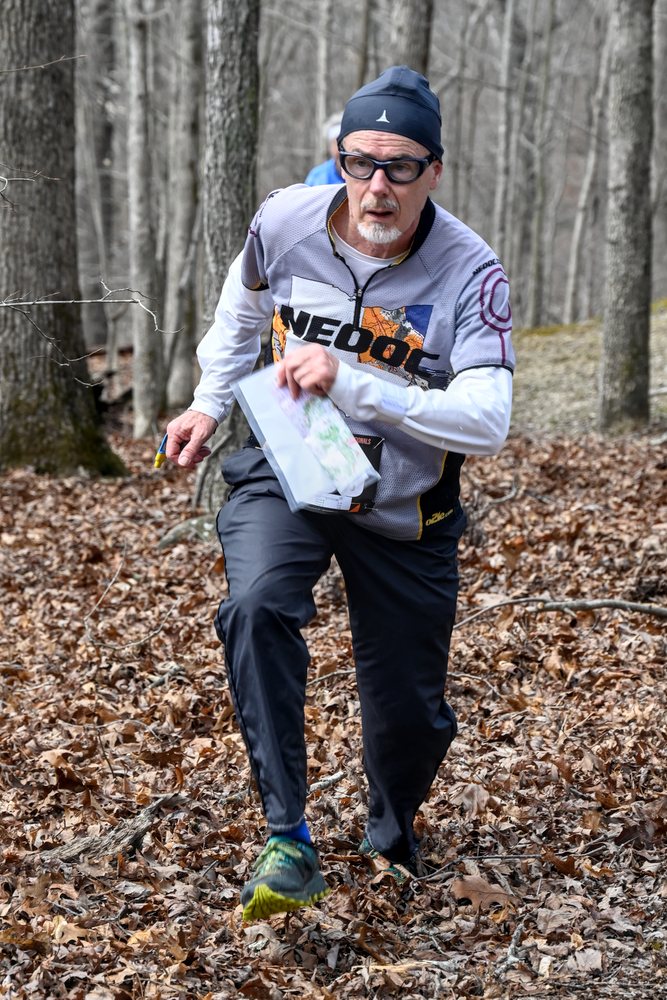
At the 50-year mark, the heart of orienteering still resonates with people of every age and ability. NEOOC is proud to sponsor events that welcome everyone: individuals and families, newcomers and seasoned experts, all looking for a new challenge. The camaraderie found in closeness to nature, and the balance of physical and mental effort, are what make this sport special. These experiences nurture participants and truly enhance their well-being. We welcome new members and offer events and orienteering training throughout the year.